Why an Ingredient's Presence Does Not Tell You the Whole Formula
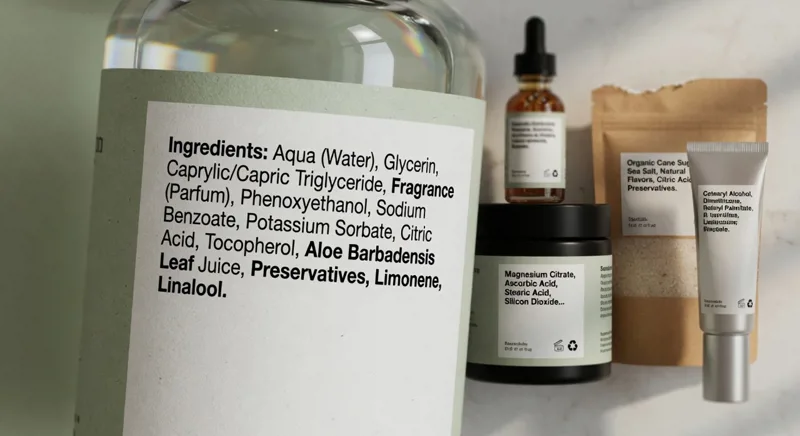
Seeing a familiar ingredient on a label can feel reassuring—or alarming. But why an ingredient's presence does not tell you the whole formula comes down to concentration, processing, ingredient interactions, and the product’s intended use. One ingredient rarely explains how an entire food, supplement, cosmetic, or household product performs.
An Ingredient List Is Not a Complete Formula
An ingredient list tells you what a product contains, but not always how much of each ingredient it contains. In foods, ingredients are generally listed in descending order by weight, with the largest component appearing first.[2][3] Cosmetic ingredients typically follow a similar order, although ingredients present at 1% or less may be listed in any order after the higher-concentration ingredients.[1]
That distinction matters. An ingredient appearing near the end of a list may be present in a very small amount, while an ingredient near the beginning may make up much of the product’s base. Without exact percentages, the label provides only part of the formulation story.
Concentration Changes an Ingredient’s Role
The same ingredient can serve very different purposes depending on its concentration. A small amount may act as a preservative, stabilizer, colorant, flavoring, fragrance component, or processing aid. At a higher level, it may become a primary functional ingredient.
For example, an acid in a food may contribute flavor and help control pH. In a skin-care formula, an acid could be used for exfoliation, preservation, or pH adjustment. The name alone does not reveal which role it plays.
This is why searching for an ingredient’s presence is not the same as evaluating a product’s safety, effectiveness, or suitability. Dose, exposure, and intended use all matter.
The Formula Works as a System
Products are designed as systems, not simple collections of isolated ingredients. Ingredients can influence one another through chemical, physical, and sensory interactions.
- Solvents can dissolve or distribute other ingredients.
- Emulsifiers can help oil and water remain blended.
- Humectants can attract and retain moisture.
- Preservatives can help control microbial growth.
- Buffers can help maintain a stable pH.
- Thickeners can change texture, spreadability, and suspension.
- Antioxidants can help protect sensitive ingredients from oxidation.
Removing one supporting ingredient may change the product’s texture, shelf life, stability, or performance—even if the headline ingredient remains unchanged. Two products may contain the same active ingredient but deliver noticeably different results because their bases and supporting ingredients differ.
Ingredient Names Do Not Reveal Quality or Source
A label may identify an ingredient by its common name, chemical name, botanical name, or a broad category such as “flavor” or “fragrance.” That name may not tell you whether the ingredient is naturally derived, synthetically produced, refined, fermented, or extracted.
Source can matter for allergies, dietary restrictions, sustainability concerns, and personal preferences. However, “natural” does not automatically mean safer, and “synthetic” does not automatically mean harmful. The relevant questions include purity, concentration, contaminants, intended exposure, and how the finished product was tested.
In some categories, certain components may also be grouped under collective terms. For example, fragrance and flavor compounds may be declared using those broad terms rather than listing every individual component.[4] As a result, the label may not provide the same level of detail as a technical specification sheet.
Why the Same Ingredient Can Feel Different in Different Products
Consider a moisturizer containing glycerin. Glycerin may support hydration, but the final experience also depends on the water content, oils, polymers, preservatives, pH, and packaging. One formula may feel light and fast-absorbing, while another feels rich or sticky.
The same principle applies to dietary supplements. A vitamin or botanical extract’s presence does not reveal its exact dose, standardization, bioavailability, or interaction with the rest of the supplement. For meaningful comparison, check the serving size, amount per serving, form of the ingredient, and any relevant quality testing.
In food, the ingredient list also does not describe the full manufacturing process. Heating, fermentation, drying, milling, and storage can affect texture, flavor, nutrient availability, and stability.
How to Read a Product Label More Carefully
- Identify the product category. Food, cosmetics, supplements, and medicines follow different labeling conventions.
- Check the ingredient order. It can provide clues about relative quantity, but it usually does not reveal exact percentages.
- Look for an active ingredient panel. Some products declare active ingredients separately from inactive ingredients.
- Review serving size or directions. Exposure depends on how much is used and how often.
- Consider the complete formula. Examine preservatives, fragrances, allergens, sweeteners, solvents, and other supporting ingredients.
- Compare like with like. Match concentration, product type, serving size, and intended use rather than comparing ingredient names alone.
The Bottom Line
An ingredient’s presence does not tell you the whole formula because labels rarely explain every concentration, interaction, processing step, or performance factor. The most useful evaluation considers the complete ingredient list, the product category, the amount used, the intended purpose, and the way the formula is manufactured.
Instead of asking only, “Does this product contain ingredient X?” ask a better question: “What role does ingredient X play in this specific formula, at this concentration, and for this intended use?” That broader view leads to more accurate product comparisons and more informed decisions.