What Humectants and Emollients Do in a Moisturizer
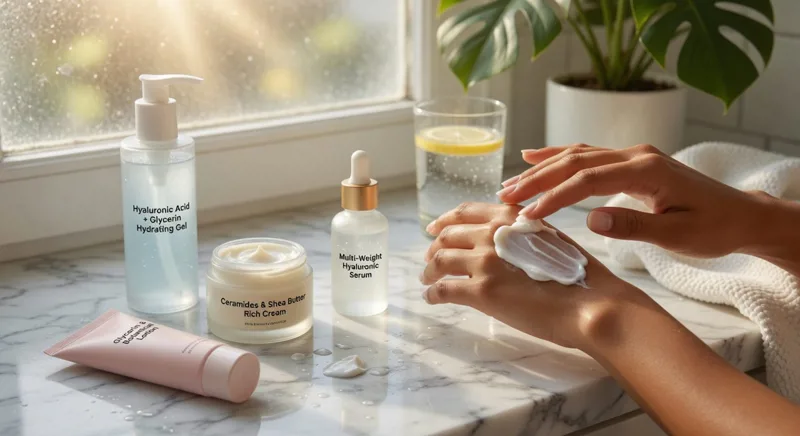
Understanding what humectants and emollients do in a moisturizer makes it easier to choose the right product for dry, tight, flaky, or sensitive skin. These ingredients work differently—but together, they help hydrate, soften, smooth, and support the skin barrier.
What Are Humectants in Skincare?
Humectants attract and hold water. They are water-loving ingredients that help increase moisture in the outermost layer of skin, known as the stratum corneum. Some can draw water from deeper layers of the skin, while others help the skin retain water from the surrounding environment.[1][2]
Think of a humectant as a moisture magnet. It helps bring water toward the skin’s surface, which can make dry skin feel more comfortable, supple, and hydrated.
Common Humectant Ingredients
- Glycerin: A popular, effective humectant that helps attract and retain water.
- Hyaluronic acid: A water-binding ingredient commonly used in facial moisturizers and serums.
- Urea: Hydrates the skin and, at certain concentrations, can help loosen rough, hardened skin.
- Lactic acid: An alpha hydroxy acid that can moisturize while gently exfoliating.
- Sorbitol and propylene glycol: Water-binding ingredients found in many lotions and creams.
- Aloe vera: A soothing, water-rich ingredient often included in lightweight formulas.
Humectants are especially useful when your skin feels dehydrated, tight, or dull. However, they are not always enough on their own. Without ingredients that slow evaporation, the water attracted by a humectant may not remain in the skin for long.
What Are Emollients in a Moisturizer?
Emollients soften and smooth the skin. Rather than primarily attracting water, they fill tiny gaps and uneven areas between skin cells. This creates a smoother surface and improves the skin’s flexibility and comfort.[1][2]
Imagine dry skin as a surface with microscopic cracks. Emollients act like soft fillers, helping make that surface feel less rough and more even. They can also reduce the sensation of tightness associated with dry or irritated skin.
Common Emollient Ingredients
- Shea butter: A rich emollient used in body creams and dry skin products.
- Ceramides: Skin-identical lipids that help support the protective barrier.
- Plant oils: Ingredients such as sunflower, jojoba, and sweet almond oil can soften the skin.
- Fatty acids: These help improve the feel and flexibility of many moisturizer formulas.
- Glyceryl stearate: An emollient commonly used to create a smooth skin feel.
- Dimethicone: A silicone-based ingredient that can smooth skin and also reduce water loss.
Emollients are helpful for rough texture, visible flaking, and skin that feels uncomfortable after cleansing. They are found in everything from lightweight facial lotions to rich creams for very dry skin.
Humectants vs. Emollients: What’s the Difference?
| Ingredient type | Main function | Common examples |
|---|---|---|
| Humectants | Attract and bind water | Glycerin, hyaluronic acid, urea |
| Emollients | Fill gaps and smooth rough skin | Shea butter, ceramides, plant oils |
| Occlusives | Reduce water evaporation | Petrolatum, mineral oil, dimethicone |
The simplest distinction is this: humectants add or attract water, while emollients improve softness and smoothness. A third category, occlusives, forms a protective layer that helps keep moisture from escaping.[2][3]
Why Moisturizers Often Combine All Three
A well-formulated moisturizer may contain humectants, emollients, and occlusives because each addresses a different part of dry skin care. Humectants draw in water, emollients smooth the skin’s surface, and occlusives help reduce transepidermal water loss—the evaporation of water through the skin.[2][4]
This combination is especially useful for dry skin, rough skin, eczema-prone skin, and a weakened skin barrier. Moisturizers containing these ingredient groups can improve hydration and help the skin feel less irritated and more resilient.[4][5]
How to Choose a Moisturizer for Your Skin
For Dehydrated or Tight Facial Skin
Look for humectants such as glycerin or hyaluronic acid, followed by emollients that help prevent a rough, tight feeling. A lotion or gel-cream may suit oily or combination skin, while a richer cream may work better for persistent dryness.
For Rough or Flaky Skin
Choose a formula with emollients such as shea butter, ceramides, or plant oils. Urea or lactic acid may also help soften thick, rough areas, although exfoliating ingredients can irritate sensitive skin when overused.
For Very Dry or Sensitive Skin
Rich creams and ointments usually contain more emollient and occlusive ingredients than lightweight lotions. Fragrance-free products are often a sensible choice if your skin is reactive or prone to irritation.
For Oily or Acne-Prone Skin
Try a lightweight, non-comedogenic moisturizer containing glycerin, hyaluronic acid, or dimethicone. Oily skin still needs hydration, especially after cleansing or using acne treatments.
How to Apply Moisturizer for Better Hydration
- Cleanse with lukewarm water and a gentle cleanser.
- Pat the skin dry rather than rubbing it.
- Apply moisturizer while the skin is slightly damp.
- Use a richer cream or ointment on especially dry areas.
- Reapply after handwashing, bathing, or whenever the skin feels tight.
Applying moisturizer to slightly damp skin can help support hydration because it gives humectants water to bind and helps emollients and occlusives slow moisture loss.
The Bottom Line
Humectants and emollients perform different but complementary jobs in a moisturizer. Humectants attract water, while emollients soften and smooth the skin by filling surface gaps. When combined with occlusives that reduce evaporation, they create a more complete approach to hydration and skin-barrier care. The best moisturizer is the one whose texture and ingredients match your skin’s needs—and that you can use consistently.