What Before-and-After Skincare Photos Cannot Prove Alone
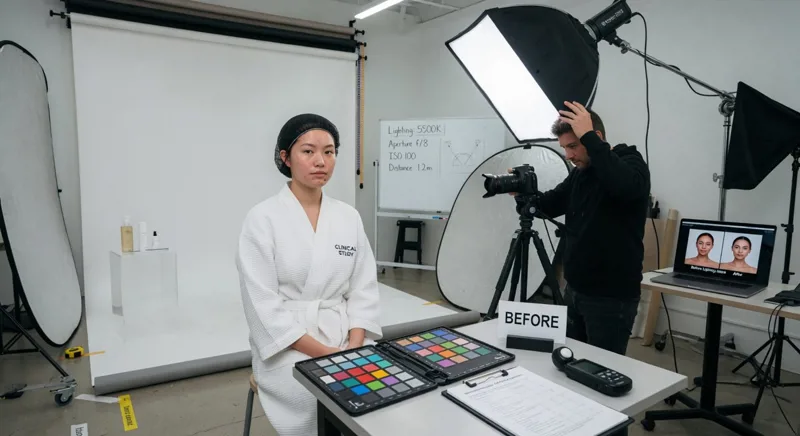
Before-and-after skincare photos can be helpful, but they are not the same as scientific proof. What before-and-after skincare photos cannot prove alone includes what caused the change, how typical the result is, how long it will last, and whether the product or treatment is safe for every skin type.
A Photo Shows a Difference—not the Cause
A pair of images may show that skin looks different over time. It cannot prove that a particular serum, cream, chemical peel, laser treatment, or acne treatment caused the improvement.
Many factors can change between the “before” and “after” image, including:
- A new skincare routine
- Prescription acne medication
- Daily sunscreen use
- Professional facials or cosmetic treatments
- Changes in makeup, diet, sleep, or stress
- Natural healing or temporary inflammation
Without a controlled comparison, the image cannot separate the effect of one product from everything else happening during the same period. This is particularly important when evaluating skincare results for acne scars, hyperpigmentation, wrinkles, enlarged pores, or rosacea.
Lighting and Camera Angle Can Change the Result
Photography conditions have a powerful effect on how skin appears. Direct flash can reduce the visibility of fine texture and wash out skin color, while angled lighting can emphasize shadows, pores, wrinkles, and facial contours.[3]
Even a small change in camera height, distance, head position, or facial expression can make the skin appear smoother or more lifted. A relaxed face may look different from a smiling face, and a tilted chin can change the appearance of jawlines, under-eye shadows, and nasolabial folds.
For a more reliable comparison, look for photos taken with:
- The same camera and lens
- Matching lighting and exposure
- The same camera distance and angle
- A consistent facial expression
- Similar background, hair position, and makeup
Clinical photography guidance recommends standardizing the camera, lens, settings, illumination, magnification, and patient position at every visit.[3] If those details are missing, treat the images as visual examples rather than conclusive evidence.
Before-and-After Photos Cannot Prove Typical Results
One impressive result does not tell you what most people experience. Marketing images may highlight a particularly successful outcome, sometimes called an “outlier,” rather than showing the average result across a larger group.
For example, one person’s acne may improve dramatically after using a retinoid, while another person with hormonal acne, sensitive skin, or deeper scarring may see little change. Skin type, age, genetics, sun exposure, medical history, and consistency all influence outcomes.
Ask whether the images represent:
- One individual or many participants
- Unretouched photos or edited images
- Different skin tones and skin types
- Typical results or the best available result
- A standardized clinical study or a personal testimonial
Advertising guidance emphasizes that before-and-after images should not exaggerate effectiveness and should be supported by evidence showing that the results are genuine and representative.[2]
They Do Not Show How Long Results Last
An after photo is only a snapshot in time. It cannot show whether smoother skin, reduced redness, or fading dark spots will remain for months or disappear after a few days.
The timing matters. Skin may look temporarily brighter after exfoliation, hydrated after moisturizer, or less inflamed after swelling subsides. Conversely, some treatments require weeks or months before their full effect appears.
When reviewing skincare results, look for a clearly stated timeline:
- Immediate or same-day results
- Two- to four-week results
- Eight- to twelve-week results
- Long-term follow-up after stopping treatment
Long-term maintenance may also involve sunscreen, prescription products, repeat procedures, or ongoing use of the original formula. A photo alone cannot reveal those requirements.
A Photo Cannot Prove Safety or Suitability
Visible improvement does not mean a product is safe for everyone. Before-and-after photos rarely show irritation, dryness, allergic reactions, worsening pigmentation, or delayed breakouts that may have occurred during treatment.
They also cannot determine whether a product is appropriate for pregnancy, eczema-prone skin, darker skin tones, rosacea, or people taking certain medications. Cosmetic claims do not require the same type of premarket approval as medicines, and the U.S. Food and Drug Administration notes that cosmetics generally do not need FDA approval before entering the market.[1]
Read the ingredient list and consider professional guidance when using active ingredients such as retinoids, hydroquinone, exfoliating acids, or strong acne treatments. A favorable image is not a substitute for a safety assessment.
How to Evaluate Skincare Photos More Carefully
- Check the timeline. Look for the exact number of days or weeks between images.
- Compare the setup. Examine lighting, angle, distance, expression, makeup, and background.
- Look for disclosure. Note whether the photos are edited, filtered, simulated, or taken under clinical conditions.
- Find supporting evidence. Clinical trials, participant numbers, standardized measurements, and independent testing provide stronger information than a single image.
- Consider the full routine. Ask what other products, procedures, medications, or lifestyle changes were used.
- Focus on realistic expectations. Improvement may be gradual and partial rather than dramatic.
The Bottom Line
Before-and-after skincare photos can illustrate a possible visible change, but they cannot prove causation, typical results, permanence, safety, or value on their own. The most trustworthy evaluation combines consistent photography with a clear timeline, transparent disclosures, clinical evidence, and information about side effects and maintenance.
Use the images as one piece of the decision—not the entire case. When a skincare claim looks extraordinary, the smartest next question is simple: What evidence supports the photo beyond the photo itself?