How to Read an Ingredient List Without Judging Every Long Word
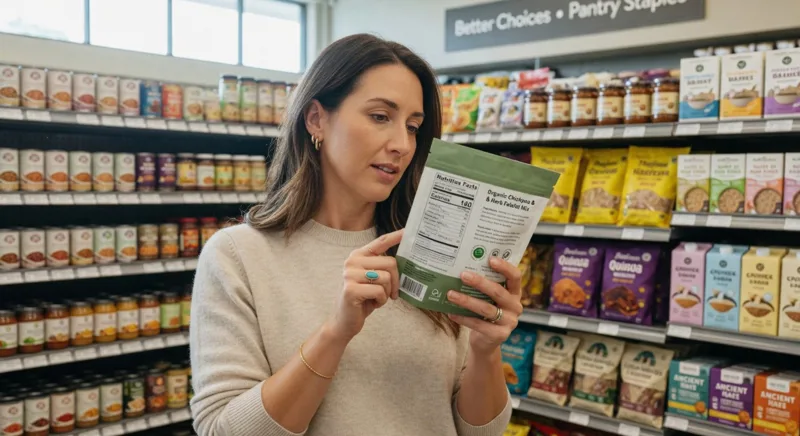
Learning how to read an ingredient list without judging every long word can make grocery shopping calmer and more informed. Instead of labeling ingredients as “good” or “bad” based on their names, focus on what they do, how much is present, and whether the product fits your personal needs.
Start With the First Few Ingredients
Ingredients are generally listed in descending order by weight, so the first ingredient is present in the greatest amount, followed by the next most abundant ingredient.[1] This makes the beginning of the list especially useful.
For example, if whole-grain flour, oats, or nuts appear near the top of a snack bar, they make up a meaningful portion of the product. If sugar, syrup, or refined flour appears first, the product is likely built primarily around those ingredients.
There is no need to judge the entire list immediately. Ask three simple questions:
- What are the first three ingredients?
- Does the list match what the package claims the food is?
- Are there ingredients you personally need to avoid?
Why Do Some Ingredients Have Long Names?
A long word is not automatically a harmful ingredient. Many scientific names describe familiar substances with precision. Tocopherols, for instance, are forms of vitamin E that may help protect a food from oxidation. Citric acid is commonly used to add acidity or balance flavor. Ascorbic acid is another name for vitamin C.
Other long names identify food additives that affect texture, shelf life, appearance, or flavor. Emulsifiers help ingredients that normally separate stay blended. Thickeners create a smoother consistency, while preservatives slow spoilage.
The key question is not, “Can I pronounce this?” It is, “What role does this ingredient play, and does it matter for me?”
A Quick Guide to Common Ingredient Categories
| Ingredient category | What it may do | Where you might see it |
|---|---|---|
| Preservatives | Help maintain freshness and reduce spoilage | Bread, sauces, packaged snacks |
| Emulsifiers | Keep water- and fat-based ingredients combined | Dressings, chocolate, spreads |
| Thickeners | Add body or improve texture | Soups, yogurt, plant-based drinks |
| Leavening agents | Help baked foods rise | Crackers, cakes, muffins |
| Colors and flavors | Influence appearance or taste | Cereals, candy, beverages |
Seeing one of these categories does not tell you everything about a product’s overall nutritional value. A food can contain a stabilizer and still provide useful nutrients. Conversely, a short ingredient list can include large amounts of sugar, sodium, or saturated fat.
Look for Allergens Before Making Broad Judgments
If you have a food allergy, the ingredient list deserves careful attention. In the United States, major allergens such as milk, eggs, fish, shellfish, tree nuts, peanuts, wheat, and soy must be identified on food labels, often in a nearby “Contains” statement.[1][2]
Always check both the ingredient list and the allergen statement. Ingredients can appear inside parentheses as sub-ingredients. For example, a product may list “chocolate,” followed by the ingredients used to make that chocolate.
Food allergies are different from preferences or sensitivities. If a food causes a serious reaction, consult a qualified medical professional rather than relying on general label-reading advice.
Understand “Natural,” “Artificial,” and “Clean” Claims
Front-of-package language is designed to attract attention, but it may not provide the full picture. Words such as “natural,” “multigrain,” “light,” or “made with real fruit” can be useful clues, yet they do not replace the ingredient list or Nutrition Facts panel.
Instead of asking whether a product sounds clean, compare the details:
- How much added sugar does it contain?
- Is fiber present?
- How much sodium is in a serving?
- Are the serving sizes realistic for how you eat?
- Does the product provide protein, vitamins, or minerals?
A product with a longer ingredient list may offer more fiber, protein, or fortification than a product with only a few ingredients. Simplicity can be helpful, but it is not a reliable measure of health by itself.
Use a Two-Minute Ingredient-List Method
- Read the product identity. Confirm what the food actually is rather than relying only on its front label.
- Scan the first three ingredients. This shows the main building blocks of the product.
- Check added sugars and sodium. Look at the Nutrition Facts panel for quantities per serving.
- Search for allergens. Review both the ingredients and any “Contains” statement.
- Notice ingredient clusters. Sugar may appear as syrup, cane sugar, honey, or another sweetener.
- Consider your own needs. A person with diabetes, celiac disease, an allergy, or a specific medical condition may need a more detailed review.
When Should a Long Ingredient List Matter?
A long list deserves more attention when it reflects a product that is highly refined, contains several forms of added sugar, or provides little nutritional value for its serving size. It may also matter if you are avoiding a specific additive because of a documented allergy, intolerance, or medical recommendation.
However, length alone is a weak measure. A frozen vegetable meal may include ingredients for a sauce, seasoning, or nutrient fortification. A loaf of bread may contain several components needed for structure and freshness. Context matters more than word count.
The Bottom Line
Reading an ingredient list without judging every long word means replacing fear with useful questions. Focus on ingredient order, allergens, added sugar, sodium, serving size, and the food’s overall nutritional role. Long names often describe practical functions—not hidden dangers. With a little practice, the ingredient list becomes a helpful tool rather than a source of confusion.